2026-10-28
Pain, Harvest Time, and Scarring to Know Before Choosing Autologous or Donor Rib for Rhinoplasty
A guide to when autologous rib cartilage is needed for rhinoplasty, how it differs from donor rib, and what to expect for pain, harvest time, and scarring.

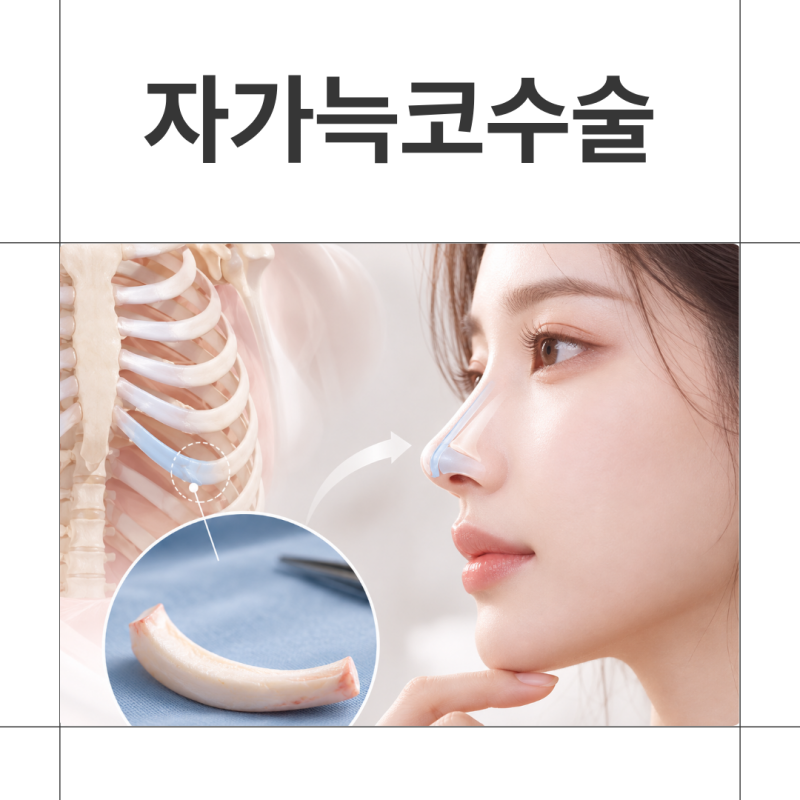
I've heard donor rib cartilage can be used as well. Why do I have to have my own rib cartilage harvested?
This is a common question among people considering autologous rib cartilage rhinoplasty.
The idea that it can firmly support the nose is appealing, but making an incision in the chest can feel like a heavy burden.
Some people are especially concerned about how it differs from donor rib cartilage and how much pain or scarring remains after the cartilage is harvested.
Today, I will explain the nose conditions that call for autologous rib cartilage, the differences between the materials, and what you should know before deciding on surgery.
What kind of nose needs autologous rib cartilage rhinoplasty?
Autologous rib cartilage rhinoplasty is a procedure in which cartilage taken from the end of your own rib is used to shape the nose.
Autologous rib cartilage is firm and can provide sufficient length and volume.
For a first rhinoplasty, septal cartilage or ear cartilage is generally considered. However, if the nose is severely short or upturned, autologous rib cartilage may be needed from the start.
For a small nose where the skin does not stretch easily, it's important to check whether firm cartilage is needed to hold the tip of the nose in the desired position.
In addition, if the nose has become rigid due to contracture, or if septal cartilage and ear cartilage were already used in a previous surgery, the amount of remaining cartilage must be checked.
Whether to use autologous rib cartilage should be judged by the condition of the nose and the level of support it needs, rather than by whether it is a first or revision surgery.
What is the difference between autologous rib and donor rib?
Autologous rib is rib cartilage taken directly from your own body.
Donor rib is cartilage obtained from another person's donated tissue.
The two materials differ right from the start, in how the cartilage is obtained.
Category | Autologous rib | Donor rib |
Cartilage source | Your own rib cartilage | Cartilage from a donor |
Separate harvesting | Chest incision required | No chest incision required on your part |
Features | Sufficient volume and firmness | Can be used without separate harvesting |
Considerations | Pain and scarring at the harvest site | Condition of the cartilage and its support strength |
Autologous rib cartilage can be considered when the skin does not stretch easily or when the tip of the nose needs to be held firmly.
Donor rib cartilage is also a material used in rhinoplasty, but for noses under constant, strong pressure, the level of support needed must be carefully evaluated.
Donor rib cartilage does not always cause inflammation, and autologous rib cartilage does not mean inflammation problems never occur.
Therefore, rather than deciding that one material is always better, it's important to consider the condition of the nose's skin together with the characteristics of the cartilage it needs.
How long does pain last after autologous rib cartilage rhinoplasty?
After autologous rib cartilage rhinoplasty, pain at the rib cartilage harvest site is most severe 2 to 3 days after surgery and gradually decreases over time.
Usually, pain subsides considerably after about a week, and after 1 to 2 weeks, discomfort noticeably decreases even with everyday movement.
Especially in the early recovery period, the chest harvest site may feel more achy and tight than the nose surgery site.
Pain can also be particularly noticeable when breathing deeply, coughing, or twisting the upper body.
During this period, rather than pushing through the pain, manage it with prescribed pain medication, and avoid lifting heavy objects or twisting your upper body forcefully.
Even after the pain has subsided, not all discomfort disappears right away.
When using the muscles around the ribs, such as when sneezing or laughing hard, mild soreness may remain for a few weeks, or for as long as one to two months.
Returning to daily life or work is generally possible about 3 to 7 days after surgery, but the actual timing depends on your recovery and activity level.
How long does the rib cartilage harvest take?
Because autologous rib cartilage is harvested through a chest incision, the time required varies depending on the surgeon's skill and harvesting technique.
Some cases take 2 to 3 hours, but I harvest rib cartilage in about 15 minutes.
This is because I have long focused on rib cartilage harvesting and rhinoplasty as head of the Autologous Rib Cartilage Center.
Harvesting autologous rib cartilage can be done under sedation rather than general anesthesia.
A shorter harvest time can also reduce the burden on the patient undergoing surgery.
Because the chest incision is short, it may also be favorable for scar healing, but how much scarring remains varies depending on individual skin characteristics.
However, the roughly 15 minutes refers only to the time needed to harvest the rib cartilage, and it differs from the total time for the entire rhinoplasty procedure.
Will a scar remain at the autologous rib harvest site?
Because autologous rib cartilage is harvested through an incision in the chest, a scar may remain at the incision site.
Donor rib cartilage, by contrast, does not require harvesting cartilage from your own chest, which makes a difference in this respect.
The size of the scar after autologous rib harvesting and how much it fades over time may vary depending on skin condition and healing patterns.
Therefore, it is difficult to apply the same scar size or recovery timeline to everyone.
If the chest incision is a concern, it's a good idea to weigh the reasons autologous rib cartilage is needed alongside the possibility of using donor rib cartilage.
Can autologous rib cartilage warp over time?
Autologous rib cartilage is a firm material, but over time it can bend, a phenomenon known as warping.
Because rib cartilage has a naturally curved shape, which part of the harvested cartilage is used also matters.
When considering warping, it's necessary to look not only at the cartilage's firmness but also at its shape and balance, and to select the appropriate portion.
One method to compensate for these characteristics is Rib Fit.
Rib Fit is a method in which autologous rib cartilage is finely processed and fitted to the shape of the nose. It can help reduce warping that may occur with whole-piece cartilage and help create a more natural nose line.
With more than 20 years of experience focused on rhinoplasty, what matters most is not simply using firm cartilage, but determining the right material for each nose.
Especially for short or upturned noses, or noses affected by contracture, both the skin condition and the characteristics of the cartilage must be considered together.
It's natural to feel worried about pain or scarring on the chest when considering autologous rib cartilage rhinoplasty.
Making an incision in another part of the body for the sake of your nose is not an easy decision.
I believe it's important to understand why autologous rib cartilage is needed for your nose's current condition, rather than assuming it is unconditionally the best material.
I hope you will carefully consider not only the changes you hope for, but also the trade-offs you may need to accept in choosing your surgical material.
Dr. Kim Hyung-taek, Chief Director, Kowon Plastic Surgery Clinic |
Let us help you find a nose that suits your face |