2026-11-14
Nose Tip Drooping After Rhinoplasty: Is Revision Surgery Needed If It Droops Again?
Explains the causes of nose tip drooping after rhinoplasty, why it looks worse when smiling, and what is checked before deciding on correction or revision surgery.
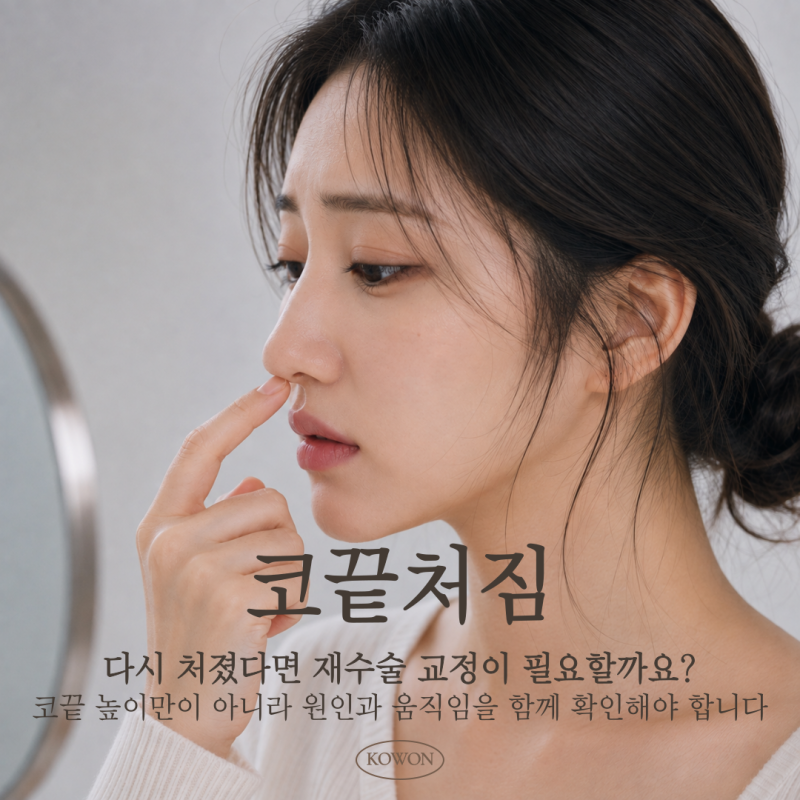
Drooping nose tip: if it droops again, is revision needed? The cause and movement must be checked, not just tip height.
Some patients say that a drooping nose tip bothers them more in photos or when they smile than when they look in the mirror.
At rest, the nose may look fine, but when they smile, the tip drops downward and the nose can look longer.
As time passes after rhinoplasty,
“My nose tip seems to have dropped compared to right after surgery. Do I need a revision?”
Some people ask this question.
However, a drooping nose tip does not always have the same cause.
We need to look at whether the tip droops even at rest, whether it drops further when smiling, and whether the structures supporting the tip have changed due to previous surgery.
Today, I will explain the causes of nose tip drooping and what we check after rhinoplasty to decide whether correction or revision surgery is needed.
Causes of Nose Tip Drooping: Why Does It Look Worse When You Smile?
If the nose tip points downward even at rest, we first check the structures that support the tip, such as the tip cartilage and the septum.
Conversely, if the nose looks fine at rest but drops only when smiling, we also need to check the movement caused by facial expressions.
This is because facial muscles, including the depressor septi nasi muscle, can affect the movement of the nose tip when smiling.
That is why, in our clinic, we do not look only at the front or side profile; we also compare a relaxed expression with a smiling one.
In practice, after many years of focusing on rhinoplasty, we often see that noses with similar-looking tip drooping may still require different checks.
1. At Rest |
• The nose tip points downward even at rest → We examine the structures that provide support, such as the tip cartilage and the septum. • Drooping is not noticeable at rest → We compare how it changes when smiling. |
2. When Smiling |
• The nose tip drops further the bigger the smile → We also examine the influence of facial muscles. • Movement of the nostril wings also increases → We compare not only the nose tip but also the surrounding movement. |
Therefore, if the drooping becomes more pronounced when smiling, it is more important to check the difference between the resting and expressive states than to measure the height of the nose tip alone.
If the Nose Tip Looks Drooped After Rhinoplasty, What Do We Check?
We do not decide whether to perform a revision based solely on the nose tip appearing lower after rhinoplasty.
First, we need to look at when the change was first noticed and what condition the structures currently supporting the nose tip are in.
Especially for a nose that has had previous surgery, we also check which cartilage was used, which areas were corrected, and the remaining tissue and scarring.
In addition, if the nose was originally an arrow nose or if the tip dropped further when smiling, one more factor needs to be examined.
If only the shape of the nose was corrected without fully accounting for the muscles that pull the nose tip downward, the tip may appear to droop again over time.
In such cases, rather than simply raising the nose tip again, we need to assess the influence of muscles involved in tip movement, such as the depressor septi nasi muscle, and, if necessary, correct the nasal muscles as well.
Therefore, for nose tip drooping after rhinoplasty, it is important to determine the scope of correction by examining not only the current height, but also the cause of the original arrow nose, the movement related to facial expressions, and the support condition of the nose tip.
What Do We Consider When Deciding on Nose Tip Correction or Revision Surgery?
The correction method for nose tip drooping is not determined by the degree of drooping alone.
First, we need to identify the cause of the drooping by examining the difference between resting and smiling, the condition of the structures supporting the tip, and so on.
Once the cause is identified, we determine how much support the nose tip needs.
In the case of revision surgery in particular, we also consider the changes in tissue and scar condition caused by the previous operation, as well as the cartilage that can still be used.
As such, a nose tip that was drooping from the start and drooping that appears after rhinoplasty may look similar on the surface, but the points to check can differ.
Therefore, rather than choosing a specific correction method first, it is important to identify the current cause of the drooping and the support condition, and then determine the scope of correction accordingly.
Q&A
Q1. When should I consider revision surgery if my nose tip looks drooped after rhinoplasty?
A revision is not decided immediately just because the nose tip appears lower. It is important to first assess your current condition, including how much time has passed since surgery and whether the change is continuing.
Q2. Can an arrow nose be corrected simply by raising the nose tip?
In an arrow nose, the shape of the nose tip is not the only factor; the muscles that pull the tip downward when smiling can also play a role. Therefore, rather than focusing only on raising the height, we must first identify which factors contribute to the drooping.
Q3. Is rib cartilage always necessary for revision surgery?
Using rib cartilage is not decided simply because it is a revision. Materials are chosen after evaluating the cartilage available and the level of support required.
If the nose tip feels lower than before, those who have already had rhinoplasty may be worried about revision surgery first.
However, it is difficult to identify the cause based only on the visible height of the nose tip.
Looking at your resting and smiling appearance, the structures supporting the nose tip, and any changes from previous surgery helps determine which checks are needed now.
We hope this article was helpful.
Kowon Plastic Surgery Clinic · Dr. Kim Hyung-taek, Director |
Let us design a nose that suits your face, together. |


Frequently Asked Questions
Do I need revision surgery right away if my nose tip droops after rhinoplasty?
No. A revision is not decided immediately just because the nose tip looks lower. It is necessary to first assess your current condition, including how much time has passed since surgery and whether the change is continuing.
Can an arrow nose be corrected just by raising the nose tip?
Not necessarily. In an arrow nose, the shape of the tip is not the only factor; the muscles that pull the tip downward when smiling can also be involved. That is why it is important to identify the factors contributing to the drooping before simply raising the height.
Is rib cartilage always necessary for revision surgery?
Using rib cartilage is not decided simply because it is a revision. Materials are chosen after evaluating the cartilage available and the level of support required.
What is checked if the nose tip droops after rhinoplasty?
We first look at when the change was noticed and the current condition of the structures supporting the nose tip. For previous surgery, we also check the cartilage used, the corrected areas, and the remaining tissue and scarring.
How is it checked if the nose tip drops only when smiling?
We compare your resting appearance with your smiling expression. We also examine the influence of facial muscles such as the depressor septi nasi muscle, as well as the movement of the nostril wings. Comparing whether the drooping becomes more pronounced when smiling versus at rest is important.