2026-11-13
Key to Escaping a Dorsal Hump and Yongko: Kowon Plastic Surgery's Nostril-Lowering Know-How
Dr. Hyeong-taek Kim of Kowon Plastic Surgery shares a case combining a dorsal hump with yongko, corrected through nostril lowering, tip cartilage work, and a balanced nasal design.
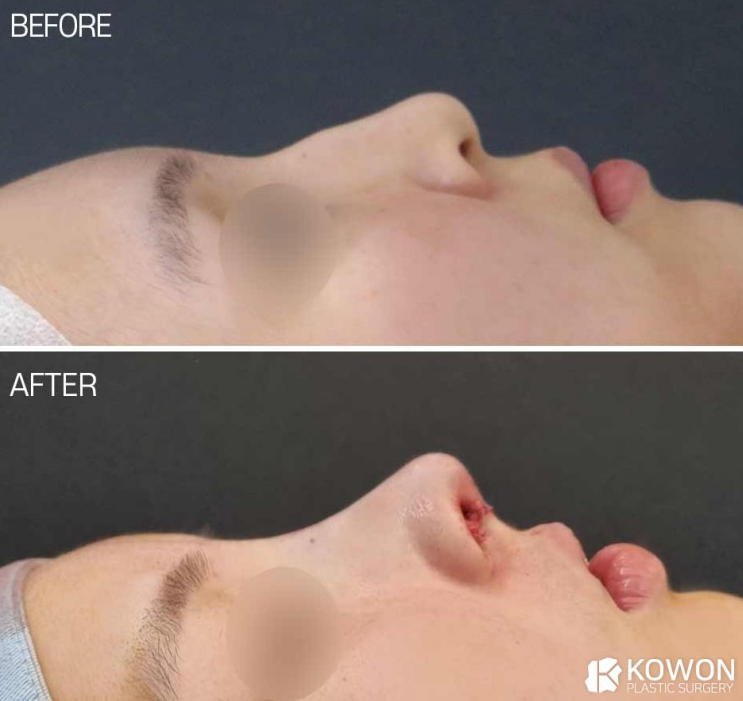

Hello, this is Dr. Hyeong-taek Kim of Kowon Plastic Surgery.
The case I saw recently was a patient with a low dorsal hump, where the middle of the nasal bridge rises slightly. On top of that, the patient had yongko (the so-called "dragon nose," a nostril-exposure type) symptoms: the outer part of the nasal ala flares upward, causing the nostrils to be overly visible from the front.
This type differs from a typical upturned nose. Because the curling of the alar wings and the outward nostril exposure are especially prominent, the nasal tip tends to look short and awkward from the front.
In addition, overall nasal bridge height was somewhat lacking, which made the hump area stand out even more. As a result, the profile looked uneven and even lacked dimension.
For cases with these characteristics, simply shaving down the hump, raising the tip, or narrowing only the nostril width has clear limitations. The overall structure must be refined by carefully examining the interrelationship between the nasal bridge and tip, and between the alar wings and nostrils.
At Kowon Plastic Surgery, we designed the hump area to be gently smoothed in proportion to the overall face so the nasal bridge line flows smoothly. Rather than forcing height alone, we adjusted it so that it blends naturally with the nasal tip.
For the tip, we first gathered the cartilage through cartilage repositioning and cartilage suturing, then added autologous cartilage to give an ideal sense of height. We placed firm supporting grafts in between to build a sturdy framework so the tip will not sag over time.
Especially in cases like this patient, where the outer part of the alar wings is lifted and the nostrils are exposed, simply pulling down the tip may not be enough. So we performed nostril lowering alongside it to correct the alar base line so it settles naturally downward.
Before-and-after side profile from Kowon Plastic Surgery: the nostrils look less exposed after surgery, with fresh stitches visible.
Here, nostril lowering is not simply a procedure to cover up the nostrils. It is a key step that finds the golden ratio between the columella and the nasal tip, reduces how often the nostrils are exposed from the front, and creates a more stable yet refined look.
Simply pulling the alar wings downward is not enough. To achieve a truly polished result, separate cartilage tissue must be grafted and firmly fixed so the alar wings cannot contract and ride back up.
We also carefully refined the columellar angle, the nasolabial angle, and the curve leading to the philtrum, guiding a smooth flow from the nasal tip down to the lip area. As a result, the previously protruding lips settled noticeably, and the side profile improved to look much more natural and refined.
Current trends focus less on simply raising the nose and more on creating lines that blend into the overall texture of the face while highlighting refined detail. Especially for yongko or nostril-exposure cases, nasal ala balance must be considered even more thoroughly.
In this case as well, we set aside excessive ambition and put each individual's personality and harmony first. By incorporating Kowon Plastic Surgery's precise nostril-lowering know-how, we found the most natural and refined shape.
[Related Case Study]
Here is a real-life improvement case related to nasal bridge augmentation. This patient wanted to define the nasal bridge line more clearly and chose yongko surgery, visiting our clinic at Kowon Plastic Surgery.
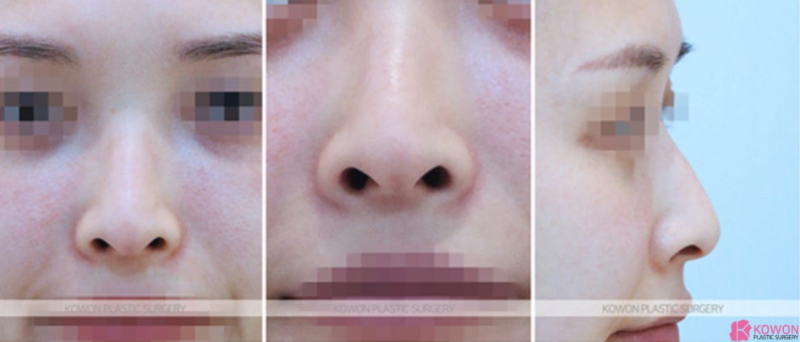
Front, low-angle and side views of a woman's nose, from Kowon Plastic Surgery.
Examining the pre-surgery appearance closely from the front, from below, and from the side, a dorsal hump was located in the middle of the nasal dorsum. Overall nose height was fairly adequate, but the structure had a narrow dorsal width.
In particular, when viewed from the front, the nasal tip was slightly upturned, giving the impression that the nostrils stood out somewhat.
An asymmetry was also observed, with the midline of the nasal bridge slightly curved to one side. Some degree of asymmetry is common in the nasal bridge, but in this case, the hump made it even more noticeable. Before surgery, the bridge was not particularly low, but the narrow dorsum and a somewhat sunken glabellar area were a point of concern.
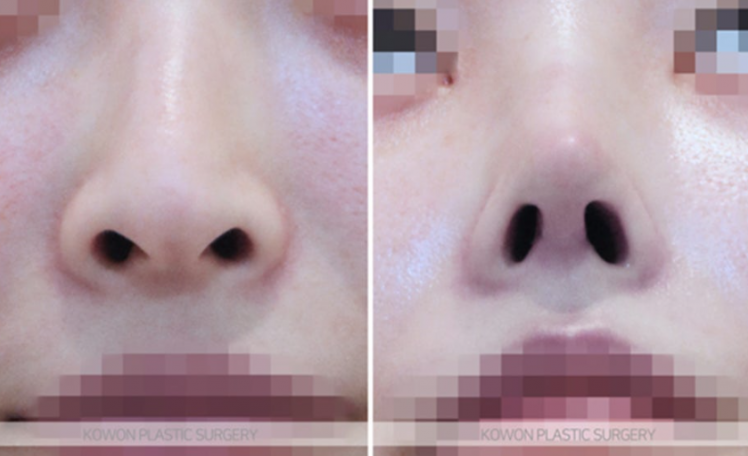
Close-ups from below comparing two noses: rounder, less visible nostrils on the left and more exposed nostrils on the right.
This patient had previously received treatment with filler and dissolving threads. To achieve a more stable and polished nasal bridge augmentation, we decided to cleanly remove the existing filler and threads before proceeding with the full yongko surgery.
Accordingly, when performing the nasal bridge augmentation, we avoided drastic changes and focused on balancing the overall structure using only a small amount of thin silicone. By reducing the burden of side effects while improving stability, the nostril exposure that had flared out to both sides decreased over time, and the twisted look from the front was refined to be much more comfortable, delivering a more natural sense of satisfaction.
[A Word from the Director]
As in this case, noses with a combination of a dorsal hump, yongko, and nostril exposure rarely achieve satisfactory results by simply raising the height or applying a one-size-fits-all approach. At Kowon Plastic Surgery, rather than pursuing excessive goals, we carefully analyze each person's anatomy and nasal ala balance, and we use delicate nostril lowering and custom design to create the most harmonious and natural lines.

A doctor in a white coat examines a patient's face during a consultation.
We are always committed to meticulously correcting even past procedure history and subtle asymmetries, so that a more stable and refined beauty can be maintained over time. If you are curious about the ideal nasal harmony that best suits your face, please feel free to reach out anytime.

Frequently Asked Questions
What approach is used when a dorsal hump and yongko occur together?
When a dorsal hump and yongko occur together, the article explains that the hump is refined in proportion to the overall face and adjusted to blend naturally with the nasal tip. When the outer part of the alar wings is lifted, nostril lowering is performed alongside.
What role does nostril lowering play?
The article explains that nostril lowering is not simply a procedure to cover the nostrils, but a key step that finds the golden ratio between the columella and the nasal tip to reduce how often the nostrils are exposed from the front. The process includes correcting the alar base line so it settles naturally downward.
Why is cartilage grafting needed in nostril lowering?
According to the article, simply pulling the alar wings downward is not enough to achieve a polished result. Separate cartilage tissue is grafted and firmly fixed to keep the alar wings from contracting and rising back up.
What if I previously had filler or dissolving threads?
In the case described in the article, the previously administered filler and dissolving threads were cleanly removed before yongko surgery was performed. The article explains that only a small amount of thin silicone was then used to balance the overall structure. Since this is one case example, the approach may not be the same in every case.
What material is used for nasal tip surgery?
According to the article, autologous cartilage is used for nasal tip surgery. After gathering the tip through cartilage repositioning and cartilage suturing, autologous cartilage is added to give height, and firm supporting grafts are placed to complete a framework so the tip will not sag over time.
Where is Kowon Plastic Surgery Clinic located?
Kowon Plastic Surgery Clinic is located on the 2nd floor of KBL Center, 110 Dosan-daero, Gangnam-gu, Seoul. The article states that the before-and-after photos were used with the patient's consent.