2026-10-07
Implant-Free Rhinoplasty: Building the Nose Bridge Line with Autologous Rib and Tissue
Implant-free rhinoplasty raises the nose using your own septal, ear, or rib cartilage. Learn how autologous tissue is chosen, what Ribfit involves, and its limits.
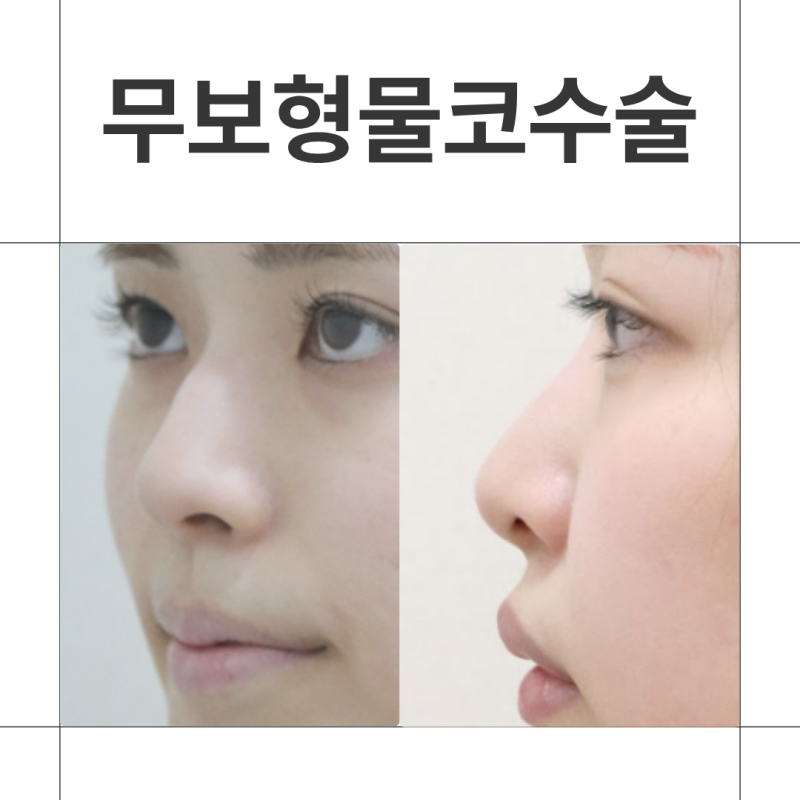
Title card reading 'Implant-free rhinoplasty' above two side-view photos of a woman's nose.
I don't want silicone implants. Can I still raise the nose bridge without an implant?
This is one of the first questions that comes up when looking into implant-free rhinoplasty.
Some people assume that without artificial implants, only the tip of the nose can be changed.
Implant-free rhinoplasty uses your own tissue, such as septal cartilage, auricular cartilage from the ear, and autologous rib cartilage. The combination of autologous tissues used varies depending on the condition of your nose and the height you want.
Today, I will explain how to raise the nose bridge without implants, the differences among autologous tissues including rib cartilage, and the cases where this approach may have limitations.
How does implant-free rhinoplasty raise the nose without an implant?
Implant-free rhinoplasty is a method that uses your own tissue instead of artificial implants such as silicone or Gore-Tex to create the height and contour of the nose bridge and nasal tip.
Septal cartilage, auricular cartilage, and autologous rib cartilage can be used, and the tissue selected also varies depending on the area being treated.
So, the term “implant-free” does not mean that no materials are used in the nose.
It is closer to meaning that your own cartilage is used instead of artificial implants.
It can also be considered by those who are concerned about an implant showing through thin skin, or who feel uneasy about using artificial implants at all.
Which autologous tissues are used for the nose bridge and the nasal tip?
Different autologous tissues can be used for the nose bridge and the nasal tip, depending on the role each area needs to play.
For the nose bridge, autologous rib cartilage or minced cartilage may be used,
while septal cartilage or auricular cartilage, among others, can be used for the nasal tip.
Rather than one type of cartilage being better in every case, it is important to determine the right combination based on your current nasal condition and the height you want.
Autologous Tissue | Application & Purpose |
Septal cartilage | Used for the nasal tip |
Auricular cartilage | Used for the nasal tip |
Autologous rib cartilage | Used to build nose bridge height, among other purposes |
Autologous rib particles | Used to secure the necessary volume of the nose bridge |
When choosing autologous tissue, it is important to look at the amount of cartilage available, the desired nose bridge height, and the level of support needed for the nasal tip, rather than simply comparing the names of the materials.
This is why the type and combination of cartilage used can differ depending on the nose's condition, even within the same implant-free rhinoplasty.
Can a low nose bridge be raised using autologous rib?
Even without implants, autologous rib cartilage can be used to create the height needed for a low nose bridge.
However, because autologous cartilage is not a pre-formed implant like silicone, there have been limitations in achieving a smooth, well-defined line while also raising the nose bridge.
To address this, there is also a method in which autologous rib cartilage is minced into particles and shaped to fit the contour of the nose bridge. At our clinic, this method is called Ribfit.
Because your own rib cartilage is finely minced and then shaped into an autologous tissue implant matching the required height and contour, the aim is to achieve the smooth nose bridge line typically expected from silicone implants, without using any artificial implant.
Therefore, Ribfit is best understood not simply as raising the nose bridge with autologous rib, but as a method applied to create both the height and the contour of the nose bridge that were difficult to achieve with autologous tissue alone.
Implant-free rhinoplasty is not possible for every nose
Just because you don't want to use artificial implants does not mean the shape you want can be achieved with an implant-free method alone in every case.
In particular, if you want a very high nose bridge or if the amount of usable autologous cartilage is insufficient, there may be limitations to its application.
• Are you concerned about an artificial implant showing through thin skin? |
• Do you want a natural-looking height and contour? |
• Can the desired nose bridge height be created with autologous tissue? |
• Is there enough usable autologous cartilage? |
Ultimately, rather than deciding on a method based solely on the condition of “not using silicone,” you need to check both the height you want and the autologous tissue currently available to you.
If there is not enough autologous cartilage, methods to secure the necessary volume will also be considered.
Is the site where autologous cartilage is harvested safe?
When autologous tissue is involved, some people worry about the donor site for the cartilage even before they think about the nose itself.
Septal and auricular cartilage are harvested only in the amount needed, within a range that does not affect function or shape, and they are used in a way that preserves the shape of the ear and the breathing function.
When autologous rib is needed, an additional step of harvesting rib cartilage is involved.
Rib cartilage is also secured through a small incision to obtain the necessary amount.
Not only which cartilage to use, but also how much to harvest and how to graft it into the nose, is included in the surgical plan.
Implant-free rhinoplasty also calls for a look at experience in selecting autologous tissue
In implant-free rhinoplasty, the process of determining which autologous tissue your nose currently needs is just as important as which material is used.
In particular, when autologous rib is used, the procedure requires not only nasal surgery but also rib cartilage harvesting, so it is also worth checking how familiar the surgeon is with working with autologous rib.
Some people find the rib cartilage harvesting process itself daunting, so it is important to secure the necessary cartilage accurately without unnecessarily extending harvesting time.
Having focused on rhinoplasty for over 20 years, consistently working with autologous rib, and performing rib cartilage harvesting in about 15 minutes are also benchmarks for evaluating this experience.
You can also check whether a single medical professional performs the surgery and whether the number of daily surgeries is limited so that the surgeon can focus on one patient's procedure at a time.
Some people considering rhinoplasty have a nose bridge and contour in mind, but feel uneasy about placing an artificial implant inside the body.
This can lead to many questions, such as whether they have to give up the look they want, or whether autologous tissue alone can get them close to the result they have in mind.
Implant-free rhinoplasty is not just about avoiding silicone. It is equally important to examine which autologous tissues can create the height and shape your nose needs.
Rather than continuing to worry vaguely about implants, I hope today's content helps you understand which options are possible for your nose.

Kowon Plastic Surgery Clinic – Dr. Kim Hyung-taek, Chief Director |
Let's find the nose that suits your face together |


Frequently Asked Questions
How does implant-free rhinoplasty raise the nose without silicone?
Implant-free rhinoplasty is a method that uses your own tissue instead of artificial implants such as silicone or Gore-Tex to create the height and contour of the nose bridge and nasal tip. Septal cartilage, auricular cartilage, and autologous rib cartilage can be used, and the tissue selected varies depending on the area being treated.
Can a low nose bridge be raised without an implant?
Yes. Even without an implant, autologous rib cartilage can be used to build the height needed for a low nose bridge. However, because autologous cartilage does not come in a fixed shape like silicone, there are limits to achieving a smooth, well-defined line. To address this, there is also a method of mincing rib cartilage into particles and shaping it to fit the contour of the nose bridge.
Is implant-free rhinoplasty possible for every nose?
No, it is not possible for every nose. If you want a very high nose bridge or if there is not enough usable autologous cartilage, its application may be limited. It is important to check together whether the desired height can be achieved with autologous tissue and whether there is sufficient autologous cartilage.
Is the site where autologous rib cartilage is harvested safe?
The clinic explains that septal and auricular cartilage are harvested only in the amount needed, within a range that does not affect function or shape. When autologous rib is needed, an additional step of harvesting rib cartilage is involved, and the necessary cartilage is secured through a small incision.
What is the Ribfit method?
Ribfit is described as a method in which your own rib cartilage is finely minced and then shaped into an autologous tissue implant to match the required height and contour. Rather than simply raising the nose bridge with autologous rib, it is explained as a method applied to create both the height and the contour that were difficult to achieve with autologous tissue alone.
What should I check during an implant-free rhinoplasty consultation?
The clinic recommends looking at the experience in selecting autologous tissue and how familiar the surgeon is with working with autologous rib. You can also check whether a single medical professional performs the surgery and whether the number of daily surgeries is limited so that the focus stays on each patient's procedure.