2026-11-04
Bulbous Nose Surgery: Is Alar Reduction Really Necessary for a Flared Nose?
Learn why a bulbous nose with flared nostril wings doesn't always need alar reduction, why the nose tip comes first, and what to check before surgery.

My nose tip is blunt and my nostril wings flare outward too. Do I need to get alar reduction along with the surgery?
Many people who look into bulbous nose surgery assume the nostril wings are what make their nose look big.
In reality, both the tip cartilage and skin thickness play a role, so it is hard to tell on your own which area needs correction.
Today, we'll talk about whether to look at the nose tip or the nostril wings first when a flared nose is your concern.
What causes a bulbous nose?
A bulbous nose is one where the tip cartilage splays out to the sides or the skin at the tip is thick, making the tip look round and broad.
It is also the most common type among Asians and Koreans.
A typical case is one where the bridge of the nose looks fine, but the tip makes the whole nose look dull, or where thick skin keeps the contour of the tip from showing clearly.
If splayed cartilage is the cause, the surgery focuses on bringing the cartilage together. If thick skin is the cause, it focuses on supporting the tip and building its contour.
What is the order of steps in bulbous nose surgery?
Bulbous nose correction is surgery that addresses the causes of a blunt nose tip to create a clearer tip contour.
Rather than reducing the nostril wings first, the surgeon shapes the tip first and then evaluates what remains.
1. Gather and reshape the splayed tip cartilage. |
2. Perform tip cartilage grafting using septal, ear, or rib cartilage to support the tip and build its contour. |
3. If the skin is thick or there is excess soft tissue, refine the soft tissue. |
4. If the nostril wings still flare out after the tip is raised, perform alar reduction at the same time. |
Is alar reduction always necessary for a flared nose?
Having a flared nose doesn't automatically mean you need alar reduction from the start.
Many people find that once the tip is lifted, the nostril wings narrow along with it, so alar reduction is often unnecessary.
For many people who are bothered by their nostril wings, the real cause is actually a low nose tip.
If you are planning tip surgery as well, it is not too late to correct the tip first and decide on the nostril wings afterward, based on the result.
Conversely, reducing only the nostril wings while the tip stays low can make the nose look even smaller, so even if the nostril wings are your only concern, the tip is evaluated too.
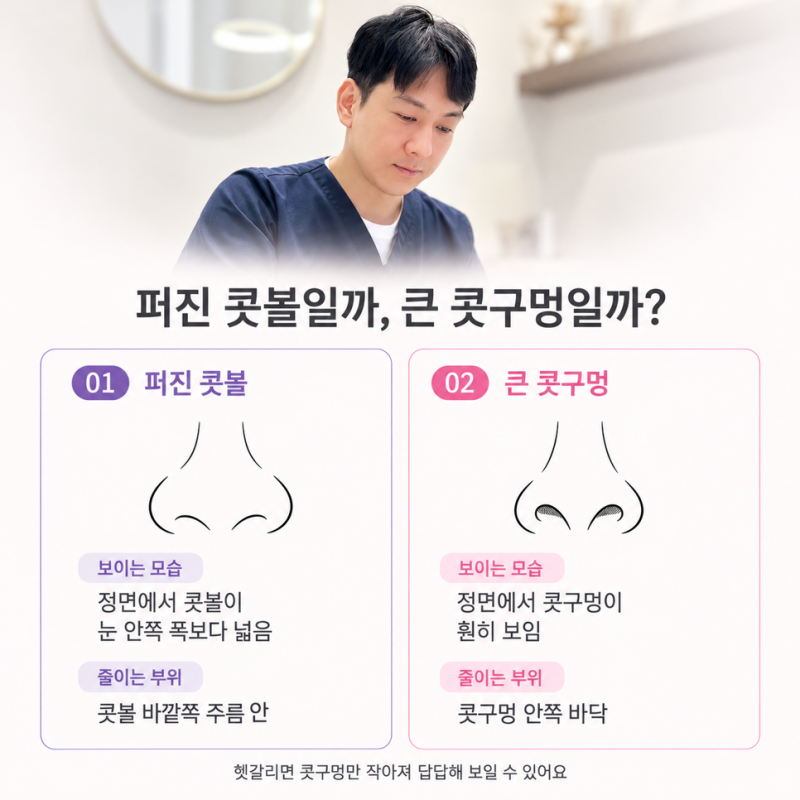
Even when alar reduction is needed, it is important to distinguish between flared nostril wings and large nostrils.
Type | Flared nostril wings | Large nostrils |
What you see | From the front, the nostril wings are wider than the distance between the inner corners of the eyes | From the front, the nostril openings are clearly visible |
Area to reduce | Inside the outer fold of the nostril wing | Floor inside the nostril |
If you confuse flared nostril wings with large nostrils, only the nostril openings get smaller, and the nose ends up looking pinched.
Overdoing it can look unnatural and can also change how the nose feels when breathing, so alar reduction should be determined by your nose tip and facial proportions rather than a set number.
Does surgery work for a bulbous nose with thick skin?
Yes, bulbous nose surgery can be effective even when the skin is thick.
However, because the outcome is strongly influenced by skin thickness, it is more realistic to expect the bluntness to be reduced and a defined contour to form, rather than a sleek, pointed tip.
If the skin at the tip feels thick when pinched between your fingers, the focus shifts to supporting the tip and building its contour rather than gathering the cartilage.
Knowing that the expected result varies with skin thickness can help you make a decision with fewer disappointments.
How long is recovery after bulbous nose surgery?
Compared with other nose types, swelling tends to last longer with a bulbous nose, and the thicker the skin, the longer it lasts.
The typical recovery is broken down by stage and varies slightly depending on the scope of surgery and any additional procedures performed. Swelling is managed with laser treatment at follow-up visits.
Timeline | Recovery stage |
Day 5 | Suture removal (Day 7 if alar reduction or rib cartilage grafting is performed together) |
2–3 weeks | Major swelling subsides |
2 months | Avoid touching or pressing the nose tip |
6 months to 1 year | The tip contour gradually becomes more defined |
Rather than judging the result based on how it looks right after surgery, it is best to give the tip contour time to settle.
What should I check when looking into bulbous nose surgery?
Bulbous nose surgery requires evaluating the tip cartilage, skin thickness, and nostril wings together to decide what to change first.
Even with the same flared nose, whether alar reduction is needed differs from person to person, so the key benchmark is how concretely the surgeon explains whether you need it.
• Whether the cause is explained separately, distinguishing between the nose tip and the nostril wings |
• Whether you can understand the reasons alar reduction is needed before deciding |
• Whether the doctor who makes the diagnosis also performs the surgery personally |
• Whether you can check the surgical process, such as through publicly shared intraoperative CCTV footage |
If your nose tip looks blunt and your nostril wings look spread out, you probably feel upset every time you look in the mirror because the whole nose seems big.
So it is only natural to want to reduce a lot all at once.
But I think it is more important to first ask whether the nostril wings need to be reduced at all, rather than how much to reduce them.
That's because many people find that correcting just the nose tip also pulls in the nostril wings that seemed to spread out.
I hope this article serves as a small guide as you go through, one by one, the reasons your nose looks rounded.

Kim Hyung-taek, Director, Kowon Plastic Surgery Clinic |
Let's find a nose that suits your face, together |


Frequently Asked Questions
Do I have to get alar reduction along with a flared nose?
No, having a flared nose doesn't automatically mean you need alar reduction from the start. Many people find that once the tip is lifted, the nostril wings narrow along with it, so the tip is corrected first and the decision about the nostril wings can wait for the result.
What causes a bulbous nose?
It is caused by splayed tip cartilage or thick skin at the tip. As a result, the nose tip looks round and broad, and it is the most common type among Asians and Koreans.
Does surgery work for a bulbous nose with thick skin?
Yes, surgery can be effective for a bulbous nose with thick skin. However, because the result is strongly affected by skin thickness, it is more realistic to expect reduced bluntness and a defined contour rather than a sleek, pointed tip.
What is the order of steps in bulbous nose surgery?
The procedure first corrects the shape of the tip, then evaluates what remains. The splayed tip cartilage is gathered, the tip is supported with cartilage grafting, and thick skin is refined through soft tissue reduction. If the nostril flare persists, alar reduction is performed at the same time.
How long is recovery after bulbous nose surgery?
The tip contour gradually becomes more defined over about 6 months to 1 year. Swelling lasts longer with a bulbous nose than with other nose types, and the thicker the skin, the longer it takes. Major swelling typically subsides in 2 to 3 weeks. The recovery process varies depending on the scope of surgery and any additional procedures performed.
How do I distinguish flared nostril wings from large nostrils?
If, from the front, the nostril wings are wider than the distance between the inner corners of the eyes, they are flared nostril wings. If the nostril openings are clearly visible from the front, they are large nostrils. The areas to reduce differ between the two: for flared wings, it is inside the outer fold of the nostril wing, and for large nostrils, it is the floor inside the nostril.