2026-10-03
Uneven Nostrils and Asymmetry After Rhinoplasty: How Long Should You Wait?
Discover why uneven nostrils occur after rhinoplasty, how asymmetrical swelling and scar tissue affect healing, and when it is safe to consider revision surgery.
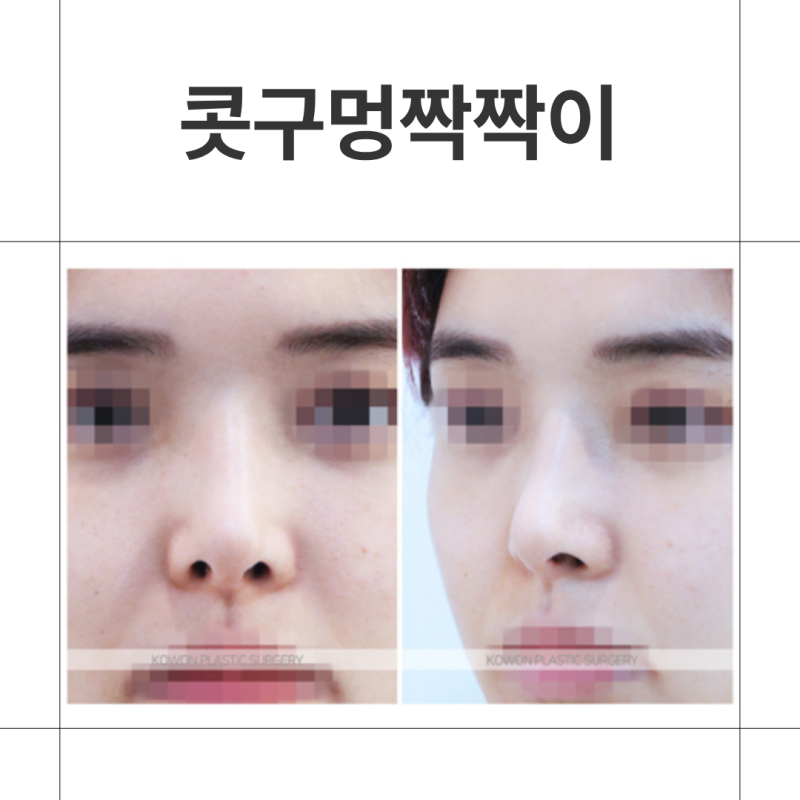
Heading reads "Uneven nostrils." Two close-up photos show a nose whose nostrils differ in shape and size.
Did the surgery go wrong?
My nose looks crooked to one side; do I need revision surgery?
Looking in the mirror after rhinoplasty and noticing that both sides look different can be quite unsettling.
It may not have bothered you before surgery, but once you start noticing the difference post-op, anxiety naturally grows.
In this situation, the first thing you need to check is not the immediate shape itself, but how much time has passed since your surgery.
This is because the time it takes for visible external swelling to resolve differs from the time needed for internal tissues to stabilize.
Not all post-operative differences stem from the same underlying reason.
In particular, you must differentiate between the appearance during the early recovery phase and the appearance after tissues have fully stabilized.
Let’s examine what to look for based on your current stage of recovery.
Table of Contents |
1. Why both sides look different in the early stages after surgery |
2. Why you should wait before judging at months 1 to 4 |
3. What to evaluate if asymmetry persists over time |
4. When to consider revision surgery |
Uneven nostrils after rhinoplasty: Assess swelling first
If you notice uneven nostrils shortly after surgery, swelling should be the first factor you consider.
Nasal swelling does not always subside at the same rate on both sides.
If more swelling remains on one side, the height and shape will look different, and from the front, the nose may appear tilted to one side.
Therefore, it is too early to judge whether the nose is truly crooked based solely on uneven nostrils immediately following surgery.
Most major external swelling subsides within one to two months.
However, just because the external appearance looks relatively natural does not mean the internal tissues have completely stabilized.
On the inside, tissues take a much longer time to heal and settle into place.
This is why you should never jump to conclusions about the final outcome based only on early visible changes.
Post-Op Stage | What to Check First |
Early Post-Op | Whether swelling is subsiding unevenly between sides |
Months 1 to 4 | Whether scar tissue remains and affects the shape |
After Full Recovery | The central nasal axis and underlying facial asymmetry |
Considering Revision | Whether internal tissues have fully stabilized |
At months 1 to 4, scar tissue must also be considered
When nostril asymmetry persists after a month or two, many people think,
"Hasn't all the swelling gone down by now?"
However, between months 1 and 4, internal scar tissue is still present, making it difficult to judge crookedness, asymmetry, dorsal lines, or tip definition as the final outcome.
During this period, one side may feel firmer or appear more swollen.
The central axis of the nose may seem deviated from the front, or uneven nostrils may look more prominent when viewed from below.
Therefore, you should evaluate the following points together:
• How many months have passed since surgery |
• Whether swelling is noticeably more pronounced on one side |
• Whether the difference between both sides is decreasing over time |
• Whether it is still during the active scar tissue remodeling phase |
As swelling and scar tissue change over time, the visible appearance also shifts.
In the early stages, rather than scrutinizing the mirror day by day, it is far better to observe how the nose evolves throughout the recovery process.
Having focused on rhinoplasty for over 20 years, I frequently meet patients who worry about whether they need revision surgery based on their immediate post-op look.
I always emphasize that allowing time for recovery is an integral part of rhinoplasty itself.
What if asymmetry remains after sufficient time has passed?
If you have waited long enough for recovery and nostril asymmetry is still noticeable, you should evaluate the nose in harmony with the overall face rather than looking at the base alone.
The human face is inherently asymmetrical.
There are subtle differences in eye height, cheekbone width, and jaw position.
If the central axis of the nose is also slightly deviated, overall facial asymmetry can appear more pronounced.
Conversely, if a face has pre-existing structural differences and the nose is mechanically aligned to the absolute center, it can look unnatural.
At this point, you should evaluate four specific criteria:
1. Have swelling and scar tissue fully resolved? |
2. Is the central nasal axis deviated to one side? |
3. Was there pre-existing facial asymmetry before surgery? |
4. Does the asymmetry persist from both frontal and basal views? |
Just because uneven nostrils remain, you should not assume that correcting that single isolated feature will solve the problem.
You must evaluate which direction the nose deviates, how the nasal midline aligns with facial balance, and the degree of original pre-operative asymmetry.
Should you undergo revision surgery right away if you are dissatisfied?
When bothered by uneven nostrils after surgery, it is easy to feel an urge to fix them as soon as possible.
However, revision surgery is generally recommended at least 6 months, and typically about 1 year, after the initial operation.
What matters even more than the timeframe of 6 to 12 months is whether the internal nasal tissues have genuinely stabilized.
If revision is attempted before stabilization, it is difficult to determine what actually needs correction, as the current shape is not final.
Intervening on tissues that have not yet settled can cause further damage and significantly prolong the recovery period.
Particularly if there was inflammation or if an implant was removed, you must wait until the area has settled and both skin and underlying tissues have fully stabilized.
In summary, keep these guidelines in mind:
Uneven nostrils immediately after surgery → Check for asymmetrical swelling first. |
Crooked appearance at months 1 to 4 → Account for persistent scar tissue in addition to residual swelling. |
Asymmetry persists after full recovery time → Assess the central nasal axis alongside natural facial asymmetry. |
Considering revision surgery → Verify that internal tissues have genuinely stabilized, rather than merely counting months. |
Ultimately, there is no need to make early conclusions about surgical results simply because you see asymmetry between both sides.
First, consider how much time has elapsed and how much swelling and scar tissue remain.
If the difference continues even after full recovery, the root cause must be identified by evaluating the central nasal axis alongside baseline facial asymmetry.
Because rhinoplasty is a procedure undertaken with high hopes, the waiting period can feel excruciating whenever you notice something concerning in the mirror.
Looking at your face daily makes it especially easy to experience emotional ups and downs over minute details.
When this happens, instead of judging the final result based on a single reflection today, focus on how swelling has subsided since the beginning and how the balance is evolving over time.
During the early recovery phase, subtle discrepancies often appear magnified, making it essential not to evaluate the ultimate result prematurely.
Healing requires time.
Only after allowing adequate time can you accurately identify any remaining concerns, which will inform the appropriate next steps.
Rather than rushing to a conclusion right now,
please remember that the time spent waiting is itself an essential part of rhinoplasty recovery.
Dr. Kim Hyung-taek, Chief Director of Kowon Plastic Surgery |
Finding the Nose That Naturally Harmonizes with Your Face |


Frequently Asked Questions
What causes uneven nostrils immediately after rhinoplasty?
It is primarily caused by differences in the rate at which swelling resolves on each side. Nasal swelling does not subside symmetrically, so if one side retains more fluid, nostril shape and height will appear uneven. It is too early to judge genuine nasal deviation right after surgery.
Do I need revision surgery if asymmetry persists at months 1 to 4?
No. During this window, healing scar tissue remains active, making it impossible to evaluate the final outcome. Tissues may feel firmer or swollen on one side, temporarily accentuating asymmetry. You should continue to monitor the healing process as swelling and scar tissue soften.
What should be evaluated if asymmetry persists after full recovery?
You should assess the nasal midline axis alongside baseline facial asymmetry. Once swelling and scar tissue have completely resolved, evaluate whether the crookedness stems from the nose itself or if it reflects natural structural asymmetry in the eyes, cheekbones, or jaw.
When is the ideal time to consider revision rhinoplasty?
It is recommended to wait at least 6 months, and preferably 1 year, until internal nasal tissues have fully stabilized. Operating before tissues stabilize makes accurate assessment difficult and increases the risk of tissue trauma. Adequate healing time is mandatory, especially after complications like infection or implant removal.