2026-10-03
Revision Rhinoplasty Success Case at a Plastic Surgery Clinic: Restoring Weakened Cartilage Support and Nasal Tip Cartilage Repositioning
A revision rhinoplasty case at Kowon Plastic Surgery, where weakened internal cartilage was rebuilt and the nasal tip was repositioned with autologous rib cartilage grafts.

Hello, this is Director Kim Hyung-taek of Kowon Plastic Surgery Clinic.
In this patient's case, they had already undergone several nasal surgeries, so the internal structure of the nose was somewhat unstable and the lines had not settled well. The proportion from the nasal tip to the nasolabial angle was off, which made the overall impression feel somewhat awkward.
In cases like this, where the nose has been operated on multiple times, the key is not simply making cosmetic adjustments, but gradually refining the central axis and overall flow of the nose while firmly rebuilding the existing internal structure.
After repeated surgeries, it is not uncommon for patients to notice changes over time, such as the nasal tip drooping or the overall height of the nose decreasing.
"The key is not simply changing the shape, but fundamentally restoring the weakened internal support."
This is because the cartilage and soft tissues inside the nose weaken from frequent contact with the hands, reducing their ability to support the original shape.
For this reason, rather than merely trying to change the outward appearance, the most essential step is to carefully reorganize the weakened internal structure and firmly restore its support.
That is why, in situations like this, it is important to examine the condition of each internal tissue in detail and approach the procedure with greater caution and precision.
This is also why we recommend getting a diagnosis at a plastic surgery clinic with extensive experience in revision rhinoplasty.
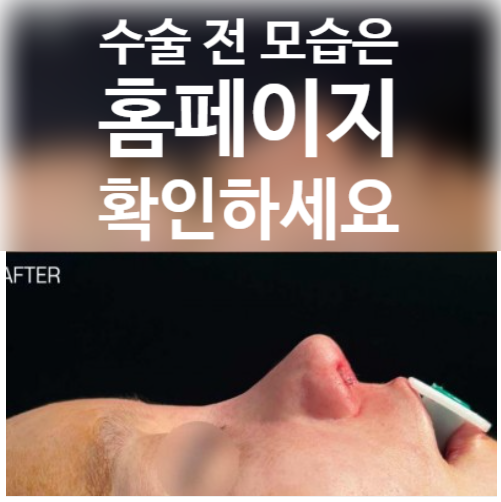
Post-surgery (AFTER) nose photo seen from a low side angle; the text says the before photo can be viewed on the clinic's homepage.
Because of the effects of previous procedures, the disordered internal shape of the nose was neatly reorganized. The nasal tip was then refined anew by repositioning the cartilage and suturing it in place, establishing a stable contour.
In addition, by placing sturdy struts between the nasal tip cartilages, we reinforced the internal structure so that the original sleek shape is well maintained over time.
"Ultimately, the secret to a high-quality result lies not only in the visible lines, but in carefully fine-tuning the internal structure that endures over time."
We also balanced the lines extending from the columella and nasolabial angle to the philtrum, easing the protruding look of the mouth and helping the transition from the nasal tip to the philtrum blend more smoothly.
In particular, thanks to the delicate adjustment of the angle, the area around the mouth now appears slightly recessed, completing a softer and more refined overall impression.
These subtle differences are exactly where the expertise of a revision rhinoplasty clinic comes into play.
[Related Case]

Post-surgery nose from an angled side view, eyes pixelated; the text says the before photo can be viewed on the clinic's homepage.
1. Background of the Case
This patient had previously undergone surgery using donor rib cartilage, but over time, the cartilage had been resorbed and the internal support had weakened significantly. As a result, the nasal tip gradually drooped, and the nasal dorsum line had become blurred and dull, making the overall impression look heavy. The patient came in with these concerns.
2. Procedures Performed
Above all, building a sturdy internal support structure was urgent, so we harvested autologous rib cartilage, which has a low resorption rate and excellent fixation strength, and used it to rebuild the nasal tip support. In addition, autologous rib cartilage granules were carefully placed along the nasal dorsum to reduce the burden on implant materials and create a natural, smooth dorsal line.
3. Outcome
The drooping nasal tip has regained its lift and settled into a defined position, and a clean, three-dimensional contour now flows smoothly from the nasal dorsum down to the tip. This case shows how revision rhinoplasty expertise in precisely handling autologous tissue can reduce the risk of side effects while further enhancing the final result. It also clearly demonstrates how important precise diagnosis and surgical skill are at a plastic surgery clinic with extensive clinical experience.
[A Word from the Director]
"For high-difficulty and complex cases, the right answer is honest surgery that rebuilds the foundation solidly from the ground up."
Even if the inside of the nose has been significantly weakened by repeated procedures, you can absolutely regain a natural, three-dimensional line, as long as the cause is accurately identified and the internal support structure is built up step by step.

At Kowon Plastic Surgery, we draw on extensive revision rhinoplasty experience and personalized one-on-one diagnosis, and we take full responsibility for refining each case so that not only the aesthetic result but also the structural stability can be maintained over the long term.
Because precise use of autologous tissue and meticulous technique are key in high-difficulty revision surgeries, we will always perform each procedure with sincerity so that you can feel secure and achieve a satisfying result. If you are concerned about the shape of your nose, we invite you to visit our clinic for a comfortable consultation.

Frequently Asked Questions
Why does the nasal tip droop after repeated nose surgeries?
Repeated surgeries can weaken the cartilage and tissues inside the nose, reducing their ability to provide support. As the internal support weakens, the nasal tip may droop or the overall height of the nose may decrease over time.
How is a weakened nasal tip structure improved during revision surgery?
The disordered internal shape of the nose is reorganized, and the nasal tip cartilage is repositioned and reinforced with supports. The cartilage is repositioned and sutured in place, and sturdy struts are placed between the cartilages to firmly reinforce the interior so that the shape is maintained over time.
How is it resolved when donor rib cartilage used in a previous surgery has been resorbed?
The nasal tip support can be improved by harvesting autologous rib cartilage and reshaping it. Autologous rib cartilage has a low resorption rate and excellent fixation strength. Placing autologous rib cartilage granules along the nasal dorsum also reduces the burden of implant materials while creating a natural dorsal line.
Why is adjusting the nasolabial angle important in revision rhinoplasty?
Balancing the columella, nasolabial angle, and philtrum lines helps tidy up the protruding look of the mouth. When the nasolabial angle is delicately adjusted, the area around the mouth appears slightly recessed, and the overall impression becomes softer and more refined.