2026-11-06
Gangnam Nose Surgery: Is Tip Cartilage Tying Enough for a Wide or Bulbous Nose?
Tip cartilage tying can suit a bulbous nose caused mainly by a wide cartilage gap, but thick tissue or weak tip support must be assessed first.

Doctor, my bulbous nose really bothers me. Would tip cartilage tying alone be enough?
This is a question many people ask when they first start considering nose surgery.
Making large changes to the nasal bridge can feel like too much. If possible, you may simply want to refine the spread-out nose tip a little.
However, even noses that look equally bulbous can have different causes.
In some cases, the problem can be approached by gathering the cartilage alone. In others, the skin and soft tissue, or the structures that support the nose tip, also need to be examined.
This is why it is important to first understand why your nose looks wide, rather than focusing only on the extent of the surgery.
Table of Contents |
1. Why a bulbous nose may not be caused by cartilage alone |
2. What should you check to see whether tip cartilage tying alone is enough? |
3. If tying alone isn't enough, which structures should be examined? |
Why a bulbous nose may not be caused by cartilage alone
"My nose tip is wide, so wouldn't it be enough to just bring the separated cartilage together?"
If the main cause is a wide gap between the alar cartilages, tip cartilage tying can be considered as the main option.
However, even noses that look equally wide can have more than one cause once you look underneath.
Reason it looks wide | What to check |
The nose tip cartilage is widely separated | How much the width changes when the cartilage is brought together |
Thick skin and soft tissue | How much the inner contour can show through on the outside |
Influence of tip support structures and overall proportions | Whether refining only the tip is sufficient |
In particular, if the skin and the tissue beneath it are thick, you may not see the sleek contour you expected, even after the cartilage is gathered.
That said, simply removing a large amount of tissue is not the answer.
The appropriate extent must be determined with consideration for the structures that maintain blood flow and the shape of the nose tip.
In reality, two or more factors, such as a wide gap in the cartilage and thick tissue, can coexist.
That is why it is difficult to choose a method based only on the outward appearance of a bulbous nose.
What should you check to determine whether tip cartilage tying alone is enough?
"So, could I just get my nose tip tied?"
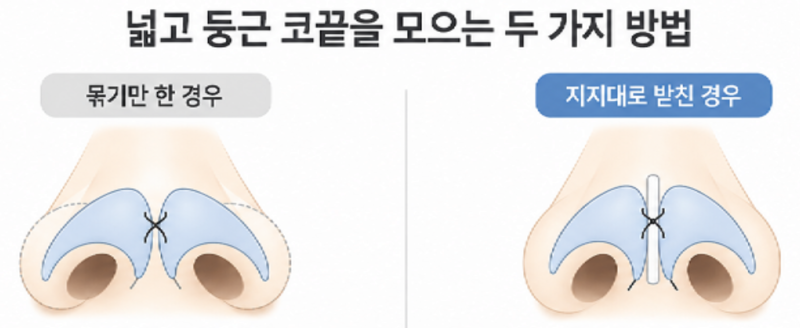
If the gap between the cartilages is the main cause of the bulbous nose, an approach can be considered that brings the cartilages on both sides of the nose tip toward the center to refine the spread-out look from the front.
That said, in our consultations we do not look only at the width of the nose tip.
We also examine the following points.
• Is the wide gap between the cartilages the main cause? |
• Are the skin and the tissue beneath it very thick? |
• Are the structures supporting the nose tip stable? |
• Does the nose tip spread widely or move downward when you smile? |
• Can the desired change be refined naturally? |
Diagram: two ways to narrow a wide, round nasal tip. Left, the cartilage is only tied; right, it is also supported by a strut.
If the main cause is the gap between the cartilages, and skin thickness or support structures play only a minor role, the plan can be built around tip cartilage tying.
Conversely, if several conditions are affecting the nose at the same time, simply deciding "how much to tie" may not be enough.
In particular, for a bulbous nose with a lot of tissue and a heavier look, you also need to assess how well the existing structure can support the tip once it has been gathered.
This is why we examine not only the front view, but also the tissue thickness and support when the tip is touched, as well as the movement when making facial expressions.
If tip cartilage tying alone isn't enough, which other structures should be checked?
"If other areas need to be checked too, does that mean I'll have to get my nasal bridge done as well?"
Not necessarily.
Checking additional structures and planning a larger surgical scope are two different matters.
If the support for the nose tip is weak, we can consider not only how to gather the cartilage but also how to support its shape.
On the other hand, a low nasal bridge should not be changed simply because it looks low. Its height relative to the nose tip and the overall proportions visible on the face should be evaluated together.
If you are researching nose surgery clinics in Gangnam, it also helps to look at whether they can answer the following questions, rather than simply comparing procedure names.
1. What is the main reason my bulbous nose looks wide? |
2. How much change can I expect from tip cartilage tying alone? |
3. If other methods are also being considered, what is the reason? |
It becomes much easier to decide how far to go once you have first heard an explanation of your own structure.
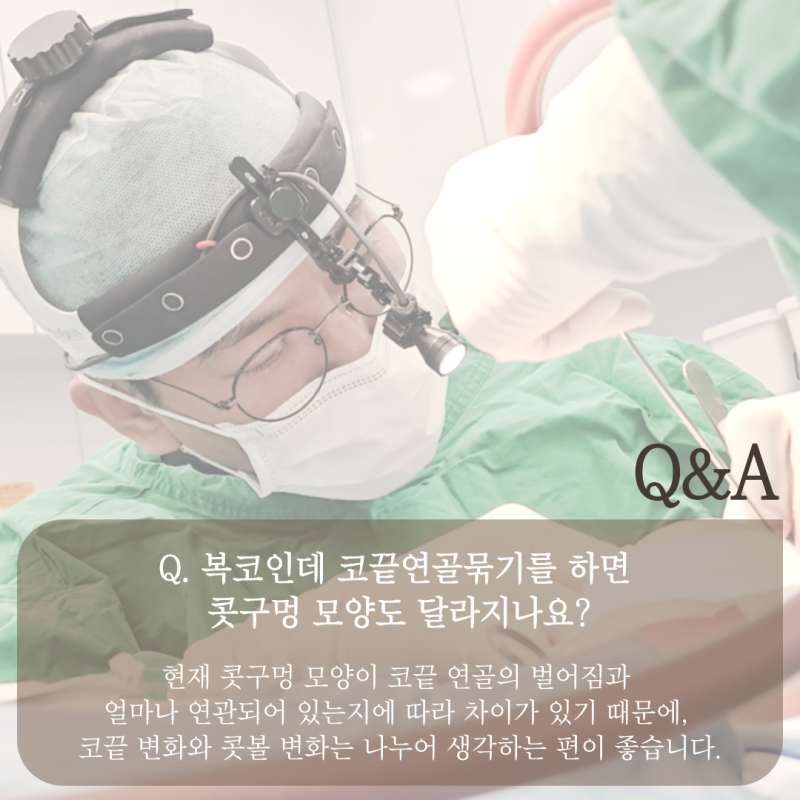
Q. Will tip cartilage tying for a bulbous nose also change the shape of the nostrils?
As the position and shape of the nose tip cartilage change, the nostrils seen from below may also change to some extent.
However, it would be a mistake to think of this as the same as narrowing the alar wings themselves.
The results depend on how closely your current nostril shape is linked to the separation of the nose tip cartilage, so it is better to consider changes to the nose tip and to the alar wings separately.
If you think "I just want to refine my nose tip a little" because of a bulbous nose, there is no need to assume a major change from the outset.
On the other hand, there is also no need to decide that it will be enough for your nose just because it is a minor procedure.
Rather than asking whether tip cartilage tying can be done,
the more important question is whether your bulbous nose has a structure that is adequately addressed by gathering the cartilage alone. I would encourage you to consider this standard first.

Kowon Plastic Surgery Clinic, Chief Director Kim Hyung-taek |
We will design a nose that suits your face, together with you |


Frequently Asked Questions
If I have a bulbous nose, is tip cartilage tying alone enough?
If the gap between the cartilages is the main cause, tip cartilage tying can be considered as the primary option, but whether it is enough depends on the underlying cause. If the skin and soft tissue are thick or the structures supporting the nose tip are unstable, the nose may not look as refined as expected even after the cartilage is gathered.
Is cartilage the only cause of a bulbous nose looking wide?
No, it may not be the only factor. A wide gap between the alar cartilages may be the main cause, but the thickness of the skin and soft tissue, the structures supporting the nose tip, and overall proportions can also have an effect.
Will tip cartilage tying change the shape of my nostrils?
Yes, some change may occur. As the position and shape of the nose tip cartilage change, the nostrils seen from below may also be affected. However, it would be a mistake to think of this as the same as narrowing the alar wings themselves.
If I have tip cartilage tying, do I also have to get nasal bridge surgery?
Not necessarily. Checking additional structures and planning a larger surgical scope are two different matters. The nasal bridge should not be changed simply because it looks low; its height relative to the nose tip and the overall proportions of the face should be evaluated together.
What is checked during a consultation?
Several factors are assessed together, including the gap between the cartilages, the thickness of the skin and underlying tissue, and the stability of the structures supporting the nose tip. The doctor also checks whether the nose tip spreads widely or moves downward when smiling, and whether the desired change can be refined naturally.
What questions should I ask during a consultation?
It helps to ask about the main reason your bulbous nose looks wide, the change you can expect from tip cartilage tying alone, and the reasons for considering other methods. It becomes much easier to decide how far to go once you have first heard an explanation of your own structure.