2026-09-15
Drooping Nasal Tip When Smiling: Achieving a Youthful Profile with Tip Revision Rhinoplasty | Kowon Plastic Surgery
Discover how revision rhinoplasty corrects a drooping nasal tip when smiling through structural reconstruction, rib cartilage grafting, and muscle correction for a youthful, lasting profile at Kowon Plastic Surgery in Seoul, South Korea. Learn about causes, techniques, and real patient outcomes under Dr. Hyung-taek Kim's expert care for natural, enduring results without repetitive sagging over time under any facial movement conditions effortlessly every day through meticulous tailor-made designs


Hello, this is Dr. Hyung-taek Kim from Kowon Plastic Surgery.
We recently had a patient visit us after noticing that their nasal tip began to droop over time following a primary rhinoplasty, causing the overall shape of the nose to lose its structural definition.
The causes of a drooping nasal tip after rhinoplasty are more varied than one might think.
When the foundational framework supporting the nasal tip is not solidly established, when the cartilage suturing lacks sufficient fixating strength, or when the weight of the overlying skin and soft tissues is not adequately taken into account, the nasal contour often deforms after a certain period of time.
In particular, if the underlying framework is too weak compared to the innate tension or thickness of the patient's cartilage, the tip can gradually tilt downward or undergo structural changes, even if it appeared quite aesthetic right after surgery.
Furthermore, if there is a history of previous revision surgeries, the internal cartilage is often weakened or damaged, significantly compromising its structural support.
"Rather than simply pulling up and securing the surface shape, the key lies in structural reconstruction—meticulously clearing internal scar tissue and rebuilding the central strut from the ground up."
After meticulously clearing the tangled internal scar tissue, we performed cartilage repositioning and suturing to clearly redefine the tip contour. By erecting a sturdy strut between the cartilages, we significantly enhanced structural stability so the shape remains preserved over the years.
When performing high-difficulty revision rhinoplasty, selecting the right graft material capable of providing strong, dependable support is paramount.
Autologous costal cartilage (rib cartilage) offers exceptional rigidity and ample length, making it ideal for erecting a strong new strut, while also helping to reinforce weakened internal tissues from previous surgeries.
For this reason, if you have long been troubled by a drooping nasal tip or have undergone multiple previous procedures, we highly recommend a structural reinforcement solution utilizing autologous rib cartilage.
Through this approach, concerns about a drooping nasal tip are cleanly resolved, achieving a stable, refined contour that remains intact without losing shape over many years.
Related Case Reference
[Reason for Visit & Initial State]
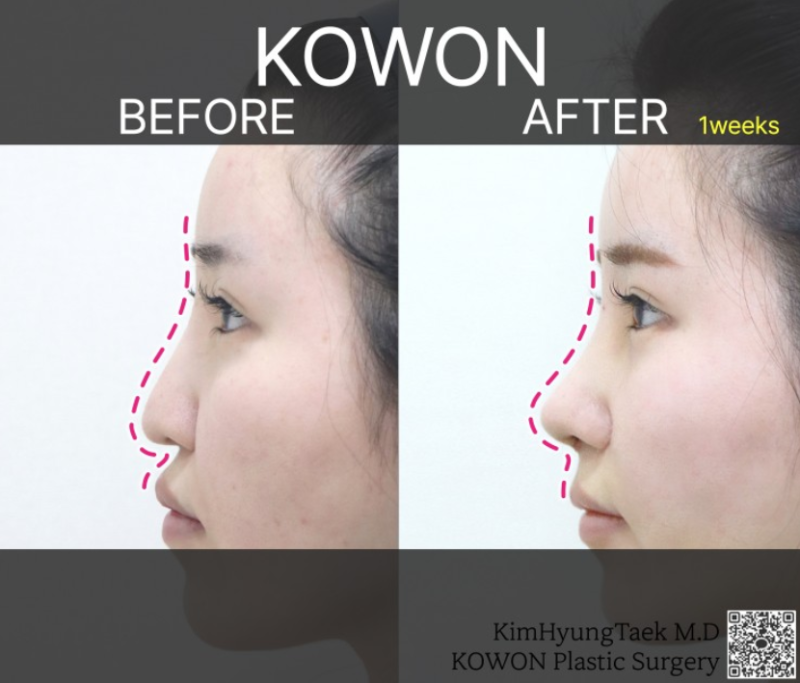
Compared to the overall facial proportions, the nose was long and the tip pointed downward. In particular, the nasal tip drooped significantly when smiling, making the midface appear elongated. This gave the face a somewhat tired and prematurely aged impression.
[Surgical Procedure & Corrections]
At Kowon Plastic Surgery, we elevated the position of the drooping nasal tip along with its highlight point, creating a smooth semi-curved (straight-curved) line. We also performed nasolabial angle correction (J-curl line), which adjusts the angle between the columella and the philtrum, thereby improving the side profile where the mouth and chin previously appeared more prominent. Additionally, because the muscles pulling the nasal tip downward when smiling were strong, we performed nasal tip muscle correction to prevent future recurrence of tip drooping.
[Transformation & Results]
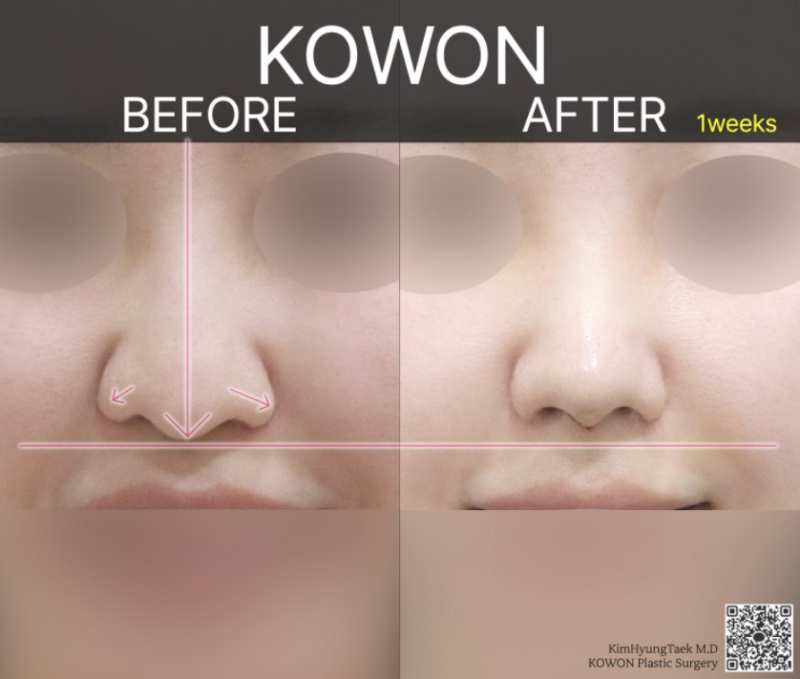
Following the surgery, the nasal tip remains firmly supported without pulling downward even when smiling, creating the visual effect of a shorter overall nose length. Moreover, the balanced harmony between the lip profile and lateral facial contours transformed the tired, somber look into a much brighter, refreshed, and youthful appearance.
By applying specialized revision rhinoplasty expertise that prevents repeated tip drooping, the patient achieved an elegantly defined, natural contour that stays stably maintained over time.
"The essence of revision rhinoplasty for tip drooping is not merely lifting the exterior, but reconstructing the collapsed internal pillar firmly from its foundation."
Leveraging extensive clinical revision experience, Kowon Plastic Surgery comprehensively analyzes each patient's cartilage anatomy, skin thickness, and even the dynamics of the muscles activated during facial expressions. We provide 1:1 tailored structural reconstruction solutions designed to maintain a sleek, natural contour that endures through the years.
With deep empathy for the emotional exhaustion caused by repeated surgeries, we promise exceptional, refined outcomes by prioritizing precision and patient safety from start to finish.
Frequently Asked Questions
Why does the nasal tip droop after rhinoplasty?
It occurs when the underlying framework and cartilage fixation supporting the tip weaken, or when skin weight and scar tissue place downward pressure on the area. If internal cartilage was damaged during a prior surgery, the lack of structural support can also lead to gradual tip drooping over time.
Can a nasal tip that droops when smiling be corrected?
Yes, it can be corrected by combining structural reconstruction with nasal tip muscle correction. By releasing or modifying the muscle pull that tugs the nose downward during facial expressions and building a strong cartilage strut, downward movement of the tip while smiling can be effectively prevented.
Why is autologous rib cartilage used in tip revision rhinoplasty?
Because it provides superior structural rigidity and adequate graft length to erect a reliable, sturdy support strut. It is ideal for reinforcing compromised frameworks from previous procedures and maintaining the corrected nasal tip shape over the long term.
What is the typical procedure for tip drooping revision rhinoplasty?
After clearing internal scar tissue, cartilage repositioning and solid strut reconstruction are sequentially performed. Rather than just lifting the surface, the procedure rebuilds the compromised internal support and, if necessary, incorporates nasolabial angle correction or nasal tip muscle correction to achieve a balanced, long-lasting contour.